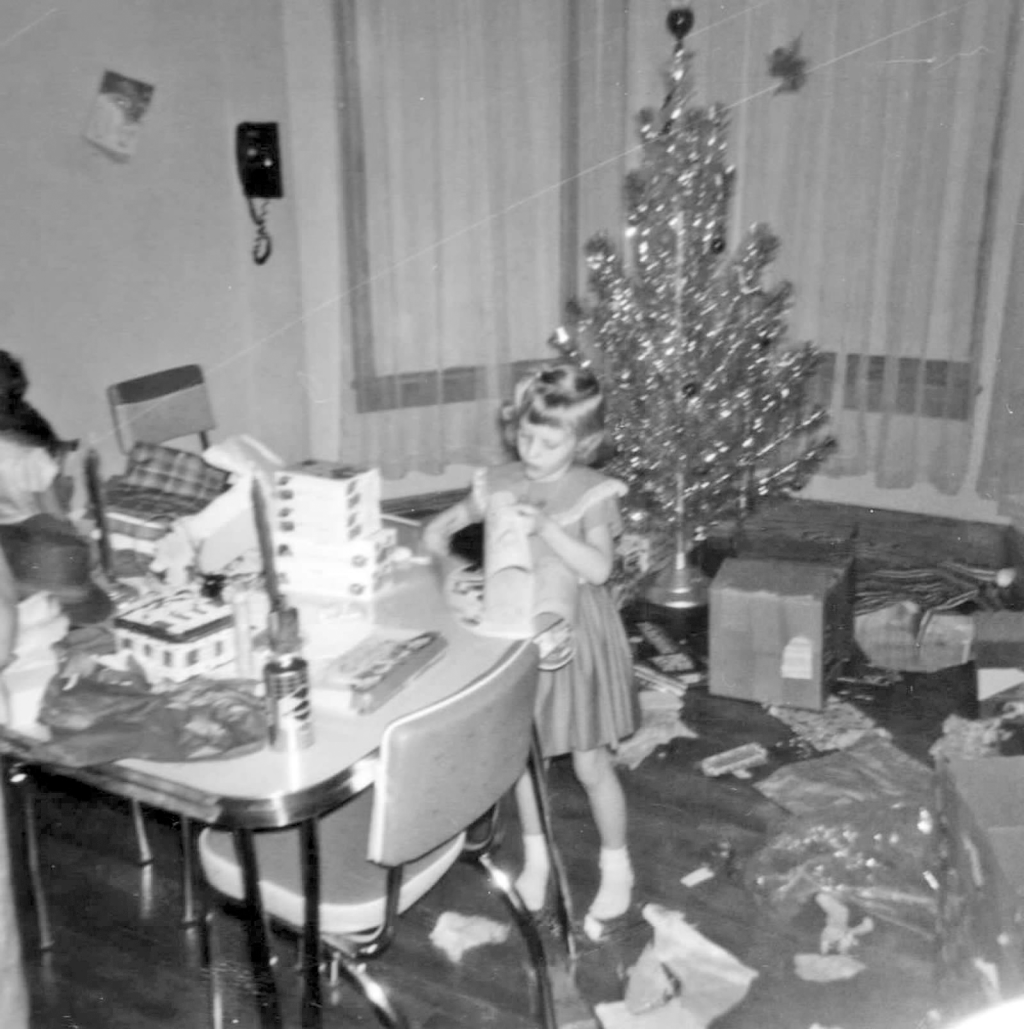
A few years back instead of sending a regular Christmas card to my family, I wrote a short story and created a Christmas Card booklet. I think it was before the advent of Shutterfly and Blurb because I printed, folded, and stapled a cover on it myself.
It’s not a New York Times bestseller, but after editing, I’m taking a chance and sharing it with you. Merry Christmas.
A Kaseman Carol
Years later they realized someone was watching them.
If only this family, reduced in number by the years, had known they were being watched, the feeling of loss and sorrow would have lifted sooner from their hearts – replaced with peace.
It was one of those very cold Decembers. The snow was so dry it was easily shoveled into banks high along sidewalks. It was weightless and weighty at the same time.
Decembers in North Dakota are not always as cold as this one, and it doesn’t always snow, but it is always dark. Days begin to lengthen only after the winter solstice. After that, real winter sets in. January in North Dakota can be quite bitter. Eventually, it rubs off on people the wrong way. We anxiously await spring.
Christmas, however, gives light to December. To celebrate the coming of the Light of the World, houses are outlined with starry yellow and white twinkling lights. At night, the houses look like lighted connect-the-dots pictures in a child’s coloring book.
North Dakota is not known for its abundance of trees. Pine or spruce trees in people’s yards remain green with the color of life, while prairie trees are blown bare by harsh north winds early in the fall.
In December’s dark, Christmas lights woven through naked limbs appear aimlessly suspended in the sky, held by some unforeseen force in random patterns resembling the distant Milky Way against a night sky. It’s a beautiful sight – endless to the horizon.
When it snows, the houses look like Christmas card paintings, peaceful under a fluffy white quilt. There’s never a guarantee that Christmas will be snowy on these rolling plains west of the 100th meridian. There’s never enough moisture. One can only count on December days growing consistently shorter and many times colder.
In reality, farmer’s fields seldom disappear completely beneath the snow. When snow does pile up, the Alberta Clipper does its best to push drifts aside, pressing snow hard into sharp scalloped edges along the fences and roads. There’s splendor in the wind as it sculpts snow along the fence lines. Winter weather offers sunrises and sunsets painted purple and pink against the oyster sky.
If you can look past the cold, it’s stunning.
A new year was coming whether anyone wanted it, or not. It would be a welcome change from this year’s end. It was filled with D-words, the ones we fear most — death, divorce, despair, depression and denial. The hurt comes from a place so deep that by the time it surfaces, it is silent as if ignoring it will make it go away.
It’s hard to share silent grief.
In this family, it was just hard to share.
That year’s gathering seemed smaller than usual, with older-than-usual family, painfully reduced in numbers by all these D-words. Sure, they talked and asked questions about those who couldn’t be home for the holidays, but mostly they ate and drank.
This family invited to Aunt Alice’s basement was no different than most, related by blood or marriage. They did not initially come together for consolation but gathered to celebrate Christmas. The unexpected blanket of comfort on this night from being with each other was their greatest Christmas gift. It was unexpected.
Life is life and there are no exceptions. Time had passed for this family as with every other person on earth. The weddings, births, baptisms and confirmations had stilled for a time between the generations. As one group aged, the next took their place in the circle of life.
In the beginning, the brothers and sisters married and there were many celebrations. Next came the birth of each child, confirmations and graduations, and happy celebrations. These years were followed by a time when children married, and the cycle continued with grandchildren.
Once the eldest, the grandparents, were gone, life seemed to settle like dust around each family as time was gobbled up with new responsibilities and growing families. Christmas had become the single occasion to stay in touch, catch up and compare notes as youngsters spread a little farther than the county of origin.
With no more grandparents the annual holiday travels to Wishek ceased. Aunt Alice assumed the role of social director. Her husband, Ed, was the youngest of the nine children — named after his father. Together they created wonderful suppers with traditional food while instigating a few new family traditions.
As usual, the invitation to gather came with a Christmas card with a spiritual theme. Family photographs were included in Alice’s cards only after the granddaughters were born.
Somehow, her appeal for an RSVP never worked. People showed up, or didn’t, without reply. It did not matter. This gracious attempt to keep the family together was greatly appreciated, even if those thanks were unspoken.
Uncle Ed was a gardener like his father before him. He practiced putting up cucumbers every fall with the hope of preserving his mother’s dill pickle recipe and, of course, his crop. Everyone enjoyed his attempts because Grandma’s pickles were the best. We missed her cooking.
That’s where Uncle Ed came in, passing along recipes and traditions of his youth. Dinner was traditionally crafted from a cultural menu – flour-and-water-based main dishes, sauerkraut-and-sausage-stuffed main dishes surrounded by vegetable sides, and almost always Jell-O salad – all mainstays of ethnic celebration menus, including those pickles.
Uncle Ed baked Christmas cookies and candy. He excelled at those old unwritten recipes of our childhood.
He also had a green thumb that far surpassed any of his brothers. Perhaps it was his desire to make things grow.
He adopted Grandma’s original Hoya plant. It grew around their entire entryway, blooming once a year with little square-pink flowers. It may have awakened around Christmas time, or maybe it was Easter.
While Uncle Ed cooked, Aunt Alice made something for everyone to take home. These presents included tissue-wrapped hand-painted glass Christmas ornaments or a clay-potted cutting from Grandma K’s, as Alice fondly called her, Hoya plant. Cuttings from that plant are still circulating amongst the family today.
One year, Uncle Ed, skilled with a wood saw, cut shapes that fit together like a three-D puzzle to create reindeer touting red Christmas bulb noses, like Rudolph.
There had to be many love tokens because, on the good years, everyone was home for the holidays. The house was filled with newborn babies to the oldest of the great-aunts and uncles. The evening always included a conversation about who were the cousins and who were the cousins “once removed.” It became a complicated, unresolved topic that brought laughter and appreciation of family to even the youngest of the clan.
This particular year, now a distant memory, was an exception to that rule.
In December’s darkness, guests arrive bundled in long woolen coats, hats, scarves and mittens.
Uncle Ed and Alice’s house was warm with candlelight. One wall of the large lower-level party room showcased a lifetime collection of antiques. Shelves lined with vintage crockery, china and yellowed linens. It was a long narrow room with a feel of closeness, but not closed in.
On the opposite wall at the bottom of the stairs, an old high-back piano filled most of the east wall. That old piano met everyone making their way carefully down the stairs balancing plates of food and Styrofoam cups of coffee in each hand.
The destination was one of two long tables with metal fold-up chairs. The edges of the seats were worn to a different color from people sliding off and on over the years.
The few souls gathered there that evening began to eat in ones and twos, the sounds of silverware and sipping hot drinks serving as conversation for the lack of things to say; or perhaps the need to say nothing.
After all, family was family, and whether one owns up to it or not, there are intrinsic similarities shared by common bonds of blood. For Germans, it was the love of food.
After dinner, perhaps for lack of any other ideas, someone suggested singing; or maybe Aunt Laverna felt like trying out that old piano. While that may not seem like such an outlandish idea in some families, it was something this group of Germans had never done before.
The only available music was a worn black hymnal placed strategically as the piano’s adornment. This book was no doubt a discard from an old country church.
Within the gold-edged pages were familiar Christmas songs and hymns from church services of years past. Weekly worship was important to the German-Russian culture.
The music and the piano were turned over to Aunt Laverna with complete confidence. She played Sundays in church and later for the St. Andrews country choir that sang for guests in their native tongue. Because of a lifetime of Christmas Eve singing, no one needed words to the old familiar carols. They sang from memory to melodies learned largely within the church.
They sang in German. They sang in English. They sang.
Each ivory key pressed in turn by Aunt Laverna’s skilled hands sent shivers to the back of the age-worn piano and to everyone standing in a circle around the old instrument. In the night’s silent darkness, those shivers carried through the air, past the Bethlehem star in the east.
The voices were varied, and far from perfect. Somehow, for that brief time, the music carried the pain away. From the dark, warm basement, the sound drifted in wisps like smoke through the seams in the walls and into the below-zero winter air.
Those creaky notes sounded pure, almost like angels’ singing. This impromptu moment might have made a bigger impact on this family choir if they had known someone was listening to their songs and hearts.
People who loved them.
Lifted by the wind, these unspoken prayers traveled to the heavens the ears of those who had gone before leaving this group of people behind to carry on traditions.
All the grandparents, husbands, brothers, sisters, sons, daughters, aunts and uncles, thought to be outside the reach of earthly bounds heard those Christmas songs that holy night.
These saints smiled a blessing on that home and all who gathered there on earth, knowing that very soon all would be together again in Heaven.
Some of the pains have changed, but some old ones remain. Many have faded with age. There are new additions through marriage and birth filling heart gaps delightfully, but more absent too. Time passed and so have Ed and Alice with most of their generation. Grandchildren move into their roles as young adults, and we become our parents – grandparents, even great-grandparents. There are no more Kaseman family gatherings during the holidays. At Christmas, we still take time to remember.
The old piano is no longer in Ed and Alice’s basement. For all anyone knows, it must have been sold or discarded, having served its singular purpose that cold winter night so long ago.
Now, more and more friends and family patiently wait for us in heaven, and on Christmas ever listening for familiar voices.
Until we meet in heaven, Merry Christmas, and never underestimate the power of your song.


 INDYchildrendotme
Leave a comment